
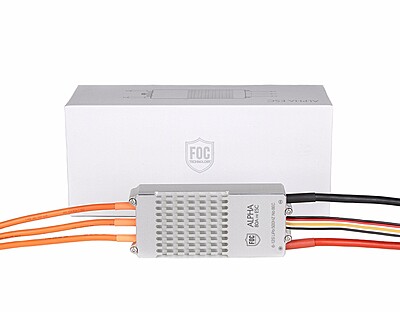
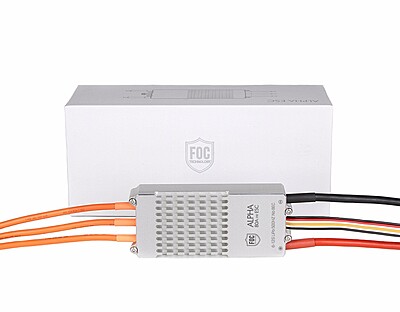
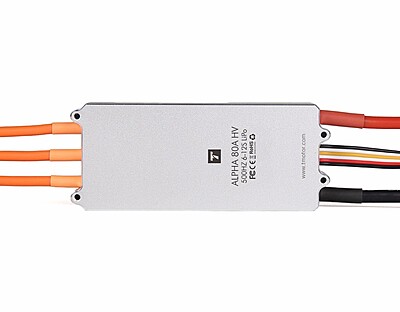
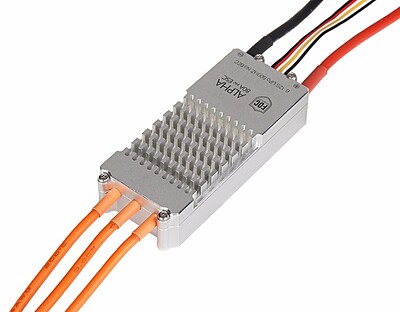
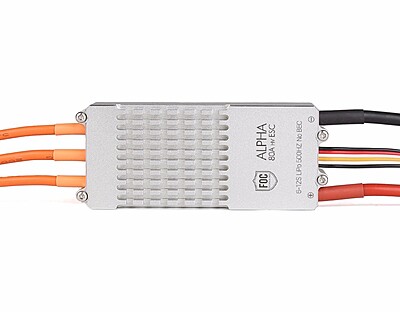
T-Motor ALPHA 80A 12S ESC - High Voltage Electronic Speed Controller for Heavy-Lift Industrial UAVs
The T-Motor ALPHA 80A 12S ESC is a high-performance speed controller with advanced FOC technology. Designed for professional-grade drones, it supports up to 12S LiPo and delivers exceptional smoothness and efficiency. This ESC ensures precise motor control and quiet operation, making it ideal for cinematic and industrial applications.
Moving far past standard square-wave drive algorithms, the ALPHA 80A utilizes a sophisticated FOC sinus-wave driving mechanism. This core calculation matches the rotor position flawlessly, generating smooth, precise torque with near-silent motor acoustics. By streamlining commutation efficiency, it lowers current ripple factors and runs the motor up to 10% more efficiently than conventional ESC configurations.
Rugged IP55 Waterproof Isolation Layout :
Agricultural spraying, mapping, and emergency response operations can't stop for dust storms or morning downpours. Tiger Motor seals this speed controller inside an anti-corrosive, thermal-polymer injected aluminum shell that carries a certified IP55 ingress rating, completely isolating internal MOS circuits from moisture, chemical mist, and airborne grit.
Active Security Protection Framework :
To ensure complete system safety during heavy payload operations, the ESC comes loaded with an array of hardware protection shields. It actively monitors flight vitals in real time, triggering instant automatic safeguards against over-current, under-voltage, stall conditions, over-temperature, and control throttle signal loss.
Lightweight and Optimized Thermal Footprint :
By avoiding bulky traditional finned heat sinks, the internal components utilize the precision machined aluminum base plate directly to reject heat. This keeps the total physical weight at a low 110g while allowing the unit to continuously sustain its massive 80A load output without experiencing thermal throttling sags.
Specification :
Brand: T-Motor (Tiger Motor)
Product Model Name: ALPHA 80A HV
Maximum Continuous Current: 80A (Sustained test conditions)
Peak Burst Current Limit: 100A (10 Seconds threshold)
Supported Battery Voltage: 6S to 12S Lithium Polymer (LiPo) / 22.2V to 44.4V Nominal
Core Motor Control Drive: FOC Sinusoidal Wave Algorithm
Input Signal Frequency: Up to 500Hz throttle pulse width modulation
BEC Power Output Line: None (Opto-Isolated design framework)
Ingress Protection Certification: IP55 Sealed Moisture Protection
Data Telemetry Interface: Digital Output Interface Port
Net Hardware Weight: 110g (Including factory pre-wired leads)
Compatible Propulsion Matches: T-Motor U8 Lite, U8 II, MN605-S, MN7005 Motors
Frequently Asked Questions :
Q1: What is the main operational advantage of using an FOC sinusoidal ESC over a standard BLDC ESC?
Ans: FOC (Field Oriented Control) drives the motor using smooth, continuous sine waves rather than harsh step blocks. This results in significantly less heat generation, quieter motor operation, quicker dynamic throttle response, and a noticeable extension in overall flight endurance.
Q2: Does the T-Motor ALPHA 80A ESC include a built-in battery elimination circuit (BEC)?
Ans: No, this is a dedicated Opto-isolated high-voltage ESC. It does not output 5V or 12V down the signal lines, protecting your flight controller from heavy voltage noise. You will need a standalone BEC module to run your avionics rail.
Q3: Can I safely wash down my agricultural drone if these ESC modules are exposed?
Ans: Yes, the ALPHA 80A carries an official IP55 rating, protecting its internal circuits from water spray, moisture, and chemical residues. However, always ensure the main power lead solder points and terminal connections are properly sealed with heat-shrink tubing.
Q4: How do I change the motor rotation direction on this Field Oriented Control ESC?
Ans: Because FOC systems require strict phase monitoring, never swap the phase wires randomly. Instead, modify the motor rotation setting directly using the official T-Motor USB linker software or by using the programming card linked to the ESC's telemetry line.