
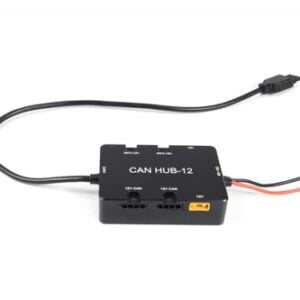
JIYI CAN HUB - Professional CAN Bus Splitter and Power Expansion Module for Drone Flight Controllers
Expand your industrial aircraft infrastructure with the high-capacity JIYI CAN HUB. Purpose-built for advanced drone flight controllers like the JIYI K++ V2, KX, and K3A Pro, this hub splits a single CAN bus line into a clean, multi-port peripheral network. Equipped with a built-in step-down power supply that accepts a massive 6S to 14S input, it distributes clean 12V power directly to high-draw commercial components. It simplifies your internal layout, eliminates wiring bottlenecks, and safely links critical systems like terrain radars, obstacle avoidance sensors, and RTK GPS modules.
The JIYI CAN HUB (specifically the CAN HUB-12 architecture) serves as the centralized digital nervous system for commercial multirotors, optimizing complex payload data flow.
Massive Peripheral Network Expansion :
Complex agricultural and industrial mapping drones use numerous external telemetry sensors. Instead of daisy-chaining components—which can introduce critical points of hardware failure—this heavy-duty CAN bus hub acts as a robust network splitter, allowing multiple CAN-based modules to transmit data simultaneously back to the primary autopilot with ultra-low latency.
Integrated 6S to 14S High-Voltage BEC :
Say goodbye to external voltage regulators and complex distribution wiring. This intelligent device features a built-in step-down step-down power converter that handles high-voltage inputs up to 14S LiPo. It steps this down internally to provide a continuous, ultra-stable 12V output, shielding sensitive radar electronics from hazardous electrical flight motor sag.
Clean Signal Routing Architecture :
By localizing your communication ports onto a single distribution block, the module drastically lowers electromagnetic interference (EMI) across your airframe. This helps you build neat, standardized avionics trays where wiring footprints are minimized and field tracing is streamlined.
Multi-Sensor Ecosystem Compatibility :
Engineered out of the box to act as the primary interface bridge for:
JIYI K++, K++ V2, K3A Pro, and KX agricultural flight systems
Precision 24GHz terrain-following and front/rear obstacle avoidance radars
High-accuracy C-RTK differential GNSS modules and multi-constellation GPS units
High-speed CAN-capable electronic speed controllers (ESCs) and custom payload triggers
Specification :
Brand: JIYI Robotics
Product Name: CAN HUB-12 Interface Expansion Module
Primary Control Interface: CAN1 (Connects directly to JIYI Flight Controller)
Input Voltage Range: 6S to 14S LiPo / LiFePO4 (22.2V to 51.8V nominal)
Output Bus Voltage: 12V CAN Data Signal Lines
Auxiliary Power Interface: 12V Output via Integrated XT30 Plug
Channel Support Capability: Multi-port branch splitting network
Housing Construction: Rugged, Shock-Resistant Thermal Polymer
Mounting Setup: Pre-molded external structural placement ears
Net Weight: 95g
Compatible Autopilots: JIYI K++ Series, KX Series, K3A Pro
Frequently Asked Questions :
Q1: Why is a CAN Hub required when building an agricultural spraying drone?
Ans: Advanced setups require multiple external systems—like terrain-following radar, obstacle avoidance sensors, RTK antennas, and flow meters. Because your flight controller has limited native CAN ports, this hub expands that single port safely to prevent bus overloading.
Q2: What is the purpose of the built-in XT30 connector on the JIYI CAN Hub?
Ans: The integrated XT30 connector taps directly into the internal step-down circuit to deliver clean, dedicated 12V power. This allows operators to run high-draw external peripherals directly from the hub without putting extra electrical strain on the flight controller.
Q3: Can I power this CAN hub directly from a 12S drone battery pack?
Ans: Yes, absolutely. The internal power management system is fully optimized to handle massive incoming voltages ranging from 6S all the way up to 14S LiPo configurations safely, eliminating the need for a secondary power distribution board link.
Q4: How does using a CAN bus network improve flight safety over older protocols?
Ans: The CAN bus protocol features extreme resistance against intense electrical noise generated by high-power ESCs and motors. It allows multiple sensors to share communication lines reliably, ensuring critical obstacle data reaches the autopilot instantly.