
GNB 350mAh 1S1P 3.8V PH2.0 70C Lipo Battery - High Voltage LiHV Whoop Battery India
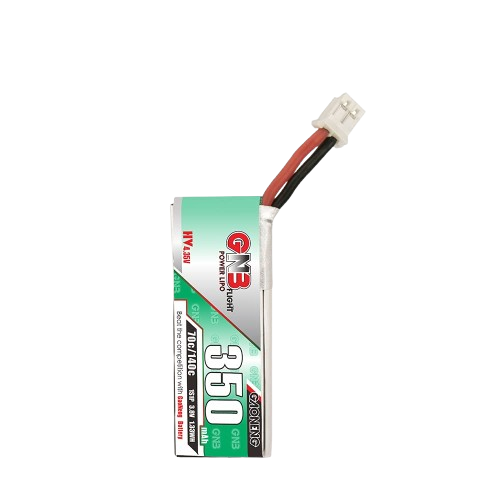
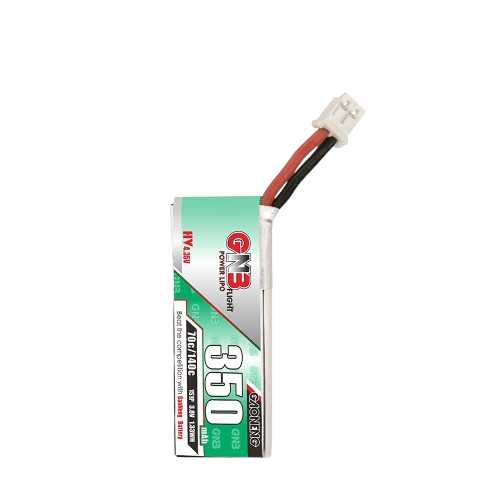
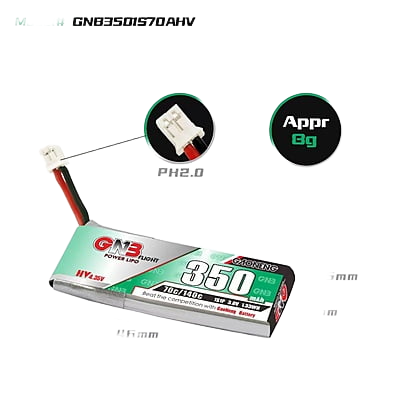
Supercharge your micro multirotor setups with the ultra-lightweight GNB 350mAh 1S1P 3.8V PH2.0 70C Lipo Battery. Purpose-built by Gaoneng for 65mm–75mm indoor tiny whoops, brushless micro quads, and sub-250g RC park flyers, this High Voltage (LiHV) pack delivers an agile 70C continuous discharge rate. Weighing in at just 8 grams, it features an integrated, low-resistance PH2.0 connector to maximize power efficiency and prevent high-throttle voltage sag during aggressive indoor maneuvers.
The GNB 350mAh 1S1P 3.8V PH2.0 70C Lipo Battery delivers the ultimate power-to-weight sweet spot for micro FPV competitors looking to maximize thrust authority and airborne agility. Moving past conventional 3.7V thresholds, this advanced High Voltage (LiHV) pack safely accepts a peak charge profile of 4.35V per cell, packing higher initial energy density into a micro form factor. This gives your brushless multirotor an aggressive throttle punch right off the starting line while noticeably extending total operational flight windows.
Key Features :
High Voltage Power Punch: LiHV chemistry allows a peak 4.35V per cell charge, delivering higher nominal voltage, reduced sag, and crisp throttle response.
Ultra-Lightweight Profile: Weighing a meager 8 grams, it minimizes total take-off mass to optimize cornering precision and save flight power.
Continuous 70C Discharge: Delivers continuous high-current pathways up to 70C to safely execute sharp flips, rolls, and low-altitude recoveries.
Low Resistance PH2.0 Lead: Fitted with a robust pre-soldered PH2.0 connector plug for solid electrical contact and efficient power transfers.
Use Cases :
Indoor FPV racing across tight technical tracks using 65mm to 75mm brushless tiny whoop frames.
Powering ultra-lightweight micro 1S toothpick quadcopters and indoor cinematic flying builds.
Power supply source for micro RC airplanes, park flyers, and lightweight custom robotics modules.
Technical Specifications :
| Specification Parameter | Product Detail |
| Brand Name | Gaoneng (GNB) |
| Model Code | GNB3501S70AHV |
| Battery Chemistry | Lithium Polymer High Voltage (LiHV) |
| Cell Configuration | 1S1P / 1 Cell / 3.8V Nominal |
| Nominal Capacity | 350mAh |
| Continuous Discharge Current | 70C |
| Peak Burst Discharge Current | 140C |
| Discharge / Charge Plug | PH2.0 Connector |
| Supported Charge Rates | 1C to 5C |
| Physical Dimensions | 6mm x 16.5mm x 46mm (H x W x L) |
| Net Hardware Weight | 8g (+/- 1g) |
Compatibility Information :
This high-performance 1S battery pack slides perfectly into standard micro battery trays. It is fully compatible with popular micro FPV drones and tiny whoops including the Emax Tinyhawk S, NanoHawk, EZ Pilot Pro, Happymodel Mobula6, Mobula7, BetaFPV Meteor65, Meteor75, and NewBeeDrone AcroBee.
Q1 ) Can I charge this GNB LiHV pack using a basic 3.7V standard LiPo charger profile?
Ans : To fully utilize the 350mAh capacity and 3.8V nominal voltage, your charger must support a dedicated LiHV charging profile that terminates at 4.35V per cell. Using a standard LiPo setting (stops at 4.20V) is safe but leaves the pack under-filled at roughly 80% capacity.
Q2 ) What is the optimal charge rate for replenishing this micro 1S battery safely?
Ans : For long-term lifecycle health, we recommend balance charging this pack at a standard 1C to 2C rate (0.35A to 0.7A). However, when you are out in the field, its robust internal cell structure can comfortably handle fast field-charging cycles up to 5C (1.75A).
Q3 ) At what minimum voltage limit should I land my tiny whoop drone?
Ans : To protect against permanent cell degradation and cell swelling, set your Betaflight OSD telemetry low-voltage warning to 3.5V under flight load. Land immediately to allow the resting cell voltage to settle safely back above a 3.7V baseline post-flight.
Q4 ) Is the PH2.0 connector plug suitable for high-current micro racing flight styles?
Ans : Yes, the pre-installed solid-pin PH2.0 connector is highly optimized for micro whoops drawing up to 70C bursts. It offers lower internal resistance and firmer contact retention than rolled-pin configurations, keeping your power line smooth during punch-outs.
Q5 ) What is the proper storage routine if I am not flying for more than 48 hours?
Ans : Never store your LiHV batteries fully charged to 4.35V or completely flat below 3.3V as it triggers internal corrosion. Connect the batteries to your storage-capable charger and bring every cell to a stable resting level between 3.80V and 3.85V.