
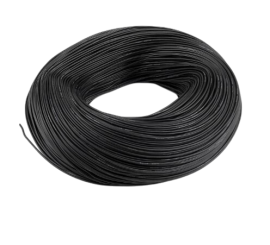
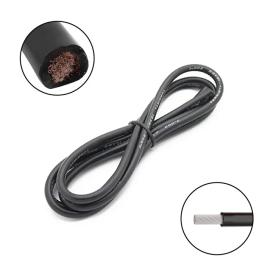
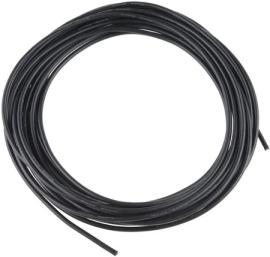
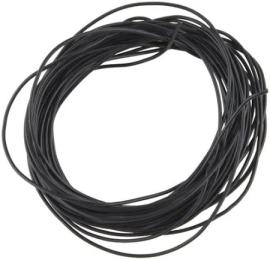
26AWG Silicon Wire BLACK 1M
In the 2026 drone landscape, where flight controllers are shrinking and peripheral counts (LiDAR, GPS, O3 units) are rising, 26AWG is a bench staple. It provides the necessary conductivity for data signals while remaining thin enough to be twisted and tucked away, reducing electromagnetic interference (EMI) and cleaning up your build.
Key Technical Advantages:
Strain Relief Flexibility: With approximately 30 micro-strands of 0.08mm tinned copper, this wire is incredibly soft. It puts almost zero mechanical tension on the tiny solder pads of modern flight controllers, preventing "pad-lift" during crashes.
Soldering Immunity: The high-grade silicone insulation is rated for -60°C to +200°C. It will not retreat or melt when you are soldering next to tiny SMD components, ensuring a professional, short-free finish.
Corrosion-Proof Tinned Core: Each copper strand is coated in tin, making it resistant to the humidity of the Indian climate. This ensures data integrity and low resistance over hundreds of flight hours.
Micro-Profile Routing: At just 1.1mm in diameter, it is perfect for internal wiring harnesses and can easily be threaded through small silicone tubes or protective mesh.
Low-Power Power Delivery: While primarily for signals, it can safely handle low-current peripherals like individual LEDs, buzzers, and low-power sensors.
FAQ: Top 5 Questions on AMASS 26AWG Black
Q1: Can I use 26AWG to power my flight controller?
A: No. Flight controllers and ESCs draw significantly more current than 26AWG can handle. Use 12AWG to 18AWG for main power. 26AWG is strictly for signals and very low-power sensors.
Q2: Is this wire suitable for DJI O3 or Walksnail signal leads?
A: Yes. It is excellent for the RX/TX, GND, and SBUS signal lines. However, for the main power input to those digital VTX units, we suggest using 20AWG or 22AWG.
Q3: Why use silicone wire instead of the standard PVC wire found in electronics kits?
A: PVC wire is stiff and its insulation melts/shrinks the moment a soldering iron touches it. AMASS silicone wire is "burn-proof" and remains flexible even after years of use.
Q4: How many amps can 26AWG safely carry?
A: For a 1-meter run, we recommend staying below 1.5A. It is perfect for cameras (~0.5A) and GPS modules (~0.1A).
Q5: Will this wire fit in a 1.25mm JST-GH or SH connector?
A: Yes, the 1.1mm outer diameter is compatible with the crimping pins for most standard micro-connectors used in the drone industry.
Expert Guide Question: Are you using this to wire up a GPS/Magnetometer or for camera signal leads? Depending on the distance from your flight controller, I can suggest the best twisting technique to minimize signal noise!