
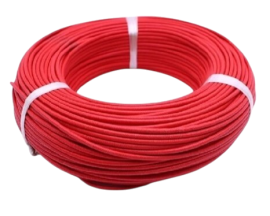
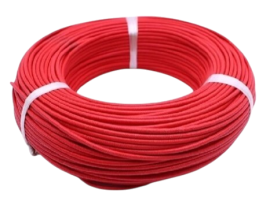
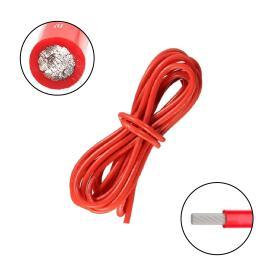
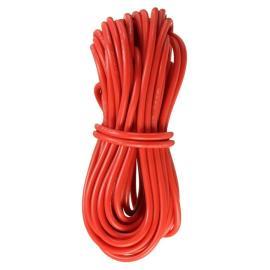
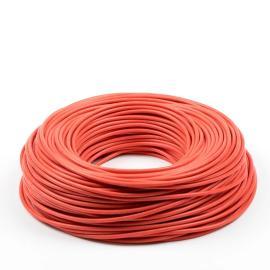
Genuine AMASS 24AWG Ultra Flexible Silicone Wire - 1 Meter (Red) - Precision 5V Power & Sensor Wire
As flight controllers in 2026 shrink and the number of micro-peripherals increases, managing the "bird's nest" of wiring is crucial. The AMASS 24AWG Red is designed specifically to deliver clean, low-amperage power without transferring physical strain to the delicate SMD components on your AIO board.
Key Technical Advantages:
Zero-Stress Routing: With approximately 40 micro-strands of 0.08mm tinned copper, this wire feels like thread. It is completely limp, allowing you to route positive power lines through complex stacks without pulling on microscopic solder pads.
Immune to Soldering Irons: The high-purity silicone insulation is rated for -60°C to +200°C. It will not shrink back, melt, or expose bare wire when you are soldering the positive and ground pads closely together, completely preventing accidental shorts.
Visual Safety: The bright red jacket is universally recognized as the positive (+) rail. In a dense micro-build, this instant visual identification prevents catastrophic reverse-polarity mistakes that could fry an expensive GPS or receiver.
Tinned for Durability: The tinned copper core prevents the oxidation prevalent in humid Indian environments. This ensures your critical 5V supply remains stable and free from voltage drops over the drone's lifespan.
Ideal for Micro Connectors: At just 1.4mm in diameter, it is perfectly optimized for crimping into the tiny pins of 1.0mm or 1.25mm JST connectors (like SH or GH plugs) commonly used for modern flight controller ports.
FAQ: Top 5 Questions on AMASS 24AWG Red
Q1: Can I use 24AWG to power my digital VTX (like DJI O3) or a flight controller?
A: No. High-power digital VTX systems and flight controllers draw significant current (often over 2A continuous, with higher spikes). Using 24AWG can cause voltage sags leading to video cutouts or brownouts. Use 20AWG or 22AWG for VTX main power.
Q2: Is 24AWG better than 26AWG for powering my receiver?
A: It depends on your preference. 26AWG is slightly lighter, but 24AWG is physically stronger and less likely to break off the pad in a hard crash. 24AWG is also much easier for beginners to strip and tin.
Q3: Can I use this for a tiny 1S brushed motor?
A: Even tiny 1S motors can pull 3A-5A, which pushes 24AWG to its thermal limit. We recommend stepping up to 22AWG for any motor connections to prevent heat buildup.
Q4: Will this fit into the tiny plugs on my flight controller?
A: Yes. The 1.4mm outer diameter is the standard size used for crimping the tiny metal pins that slide into JST-SH (1.0mm pitch) and JST-GH (1.25mm pitch) connector housings.
Q5: Why does silicone wire cost more than standard PVC wire?
A: Silicone wire uses hundreds of microscopic copper strands (for flexibility) rather than a few thick strands, and it is wrapped in an expensive, heat-resistant rubber that won't melt during soldering. It is a necessary upgrade for reliability in high-vibration UAVs.
Expert Guide Question: Are you using this Red wire to route 5V power to a receiver or 3.3V to a compass/GPS? If you are running long wires to a GPS mast, I can suggest the best braiding technique (twisting the red, black, and signal wires) to minimize electromagnetic interference!