
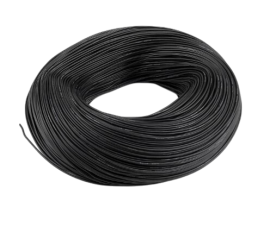
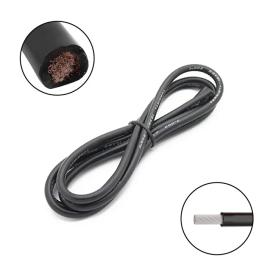
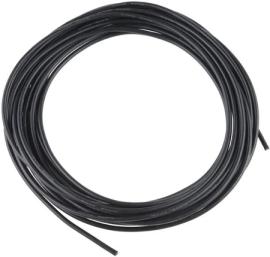
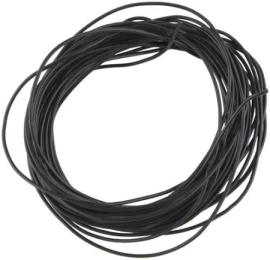
16AWG Silicon Wire BLACK 1M
In the 2026 FPV landscape, where weight-saving is as critical as power delivery, 16AWG is the "sweet spot" gauge. This wire is specifically engineered to handle the high-frequency vibrations and extreme thermal cycles of modern brushless motors.
Key Technical Advantages:
Micro-Strand Architecture: With approximately 252 strands of 0.08mm tinned copper, this wire is so flexible it can be routed through the tightest carbon fiber gaps without fear of internal fatigue or wire breakage.
Tinned for Longevity: Each copper strand is coated in tin to prevent the "black wire" corrosion common in humid Indian environments. This ensures your solder joints stay strong and your resistance stays low over the life of the drone.
Soldering-Friendly Jacket: The high-grade silicone insulation won't shrink, melt, or pull back when you're soldering to small ESC pads. It maintains its structural integrity even if you have to stay on a joint a few seconds longer than planned.
Optimal for Sub-250g Builds: For 3-inch and 3.5-inch quads (like the 2026 Cinewhoop generation), 16AWG provides the necessary ampacity for 30A–40A ESCs while saving significant grams compared to 14AWG.
Anti-Vibration Properties: The soft silicone jacket acts as a natural dampener, helping to isolate electrical noise from reaching the motor phase wires, which can improve gyro performance on sensitive builds.
FAQ: Top 5 Questions on AMASS 16AWG Wire
Q1: Can I use 16AWG as the main battery lead for a 5-inch 6S quad?
A: We don't recommend it. For the main battery pigtail on a high-power 5-inch quad, you should use 12AWG or at least 14AWG. 16AWG is best used for individual motor leads or the main power for smaller 3-inch to 4-inch drones.
Q2: Why is Black wire used more often than Red for motors?
A: In most FPV builds, all three motor phase wires are typically Black for a "stealth" look. This 1M Black wire is perfect for cutting into three equal lengths to wire up a single high-performance motor.
Q3: Is this wire "Tinned Copper" or "CCA" (Copper Clad Aluminum)?
A: This is Genuine Tinned Copper. Avoid CCA wire at all costs in drones; it has much higher resistance, breaks easily under vibration, and is difficult to solder correctly.
Q4: Will the insulation melt if I'm soldering it to a 4-in-1 ESC?
A: No. Because it’s genuine high-temp silicone (rated to 200°C), it won't melt or pull back like cheap PVC-insulated wires. It’s very "newbie-friendly" on the soldering bench.
Q5: How many strands are actually in the 16AWG wire?
A: AMASS 16AWG typically features 252 strands of 0.08mm wire. This ultra-high strand count is what gives it that "shoelace" flexibility.
Expert Guide Question: Are you using this to wire up new motors or as a power lead for a Cinewhoop? Depending on your motor's KV and battery voltage, I can help you confirm if 16AWG will handle your peak amp draw without any voltage drop!